FLYING & GLIDING
Flying and gliding are probably two of the most unique and exciting activities offered in the RAFAC and there are a number of ways to experience them. From Air Experience Flying and Gliding on a weekend to flying in RAF aircraft at camps, cadets have a number of opportunities to go flying and gliding throughout the year.
Air Experience Flying
|
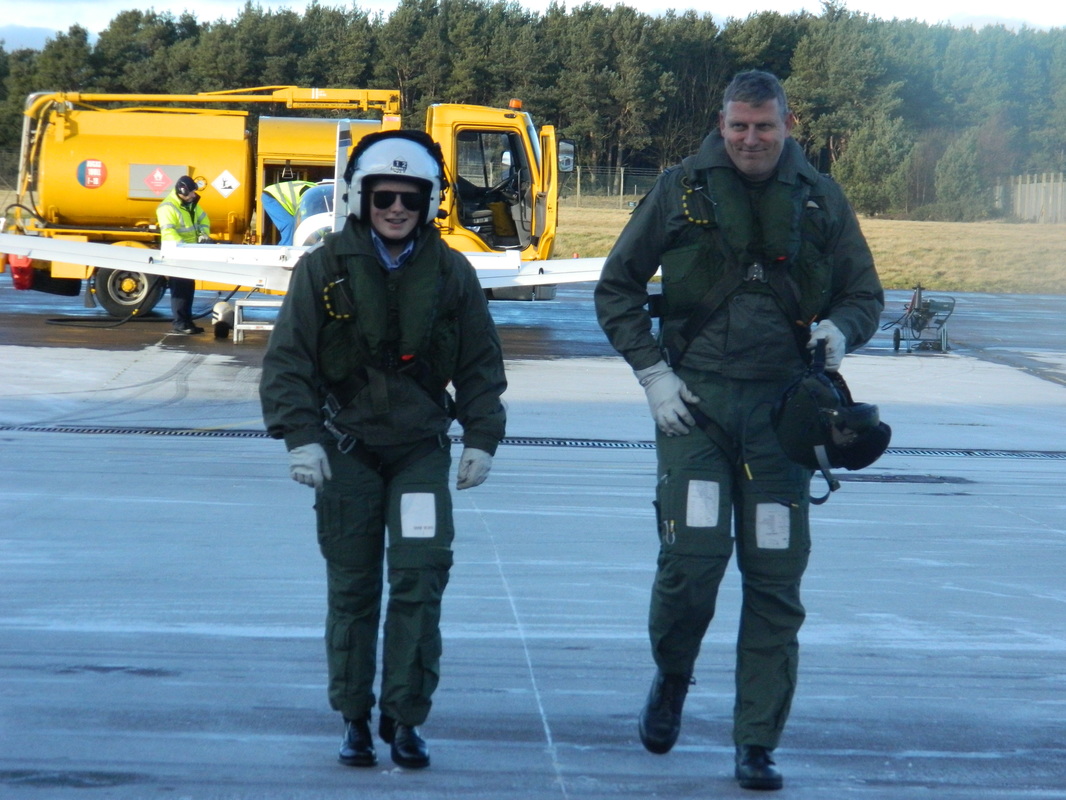
The majority of flying in the Air Cadets is provided by Air Experience Flying (AEF) squadrons based at RAF bases throughout the UK. Our local AEF (12 AEF) based at Leuchars. All AEF squadrons operate the Grob Tutor basic trainer aircraft, piloted by RAF and ex-RAF pilots.
A typical AEF flight lasts around 30 minutes, during which cadets are allowed to take control of the aircraft and perform some basic manoeuvres themselves. If cadets are keen, the pilots can demonstrate and allow the cadets to try manoeuvres such as Loops, Stall Turns & Barrel Rolls. In addition to the flying places allocated to squadrons, cadets often get the opportunity to go flying at annual camps. |
Opportunity Flights
|
On annual camps at RAF bases, cadets may be offered the opportunity to fly in RAF aircraft alongside the aircrew. For any cadets interested in a flying career (civilian or military) this is an excellent chance to speak to the aircrew and get answers to questions they may have. Previous camps have seen cadets get flights in the following aircraft:
|
Air Cadet Pilot Scheme (ACPS)

|
The Air Cadet Pilot Scheme is open to cadets who are 16 and over and who have ideally completed a Gliding Scholarship to Solo standard. Additionally, the cadet must have achieved (or expect to achieve) Standard Grade English/Maths at grade 1-3.
There are two types of course, each lasting approx. 14 days:
Additionally, any cadet achieving a UK CAA or European JAA Private Pilot’s Licence (PPL), through sponsorship or through private means, is entitled to wear the Air Cadet Pilot Wings regardless of where the course was conducted. |
Air Cadet Pilot Navigation Training Scheme (ACPNTS)

|
The Air Cadet Pilot Navigation Scheme is open to Cadets who are 16 and over, who have ideally completed a Gliding Scholarship and have passed the ATC Air Navigation exam. Additionally, the cadet must have achieved (or expect to achieve) Standard Grade English/Maths at grade 1-3.
Courses are approximately 14 days long and are delivered at AEFs across the UK. The course consists of ground based air navigation theory & training and 8 airborne exercises in a Grob Tutor aircraft, lasting a total of 8 hours. Cadets who successfully complete the course with a recommendation from OC AEF are awarded the Air Cadet Pilot Navigator Wings. |
Gliding Induction Course
|
Gliding in the Air Cadets is provided by a network of Volunteer Gliding Squadrons (VGSs) based throughout the UK. Our local VGS (661 VGS) based at RAF Kirknewton in West Lothian operates the Grob Viking winch-launched glider. Other VGSs may operate winch-launched gliders, aero-towed gliders or powered gliders.
Cadets are introduced to gliding through a series of Gliding Induction Courses (GICs):
A certificate is awarded by the VGS on completion of each stage of the GIC syllabus. |
Gliding Scholarship
|
The Gliding Scholarship (GS) course is open to all Cadets who are 16 and over. It provides 8 hours flight training in the Vigilant or 40 launches in the Viking with the aim of training cadets to solo standard. Courses can be taken either as a continuous week-long course or over successive weekends until completed. Cadets completing the full syllabus are awarded the Blue Wings.
|
Gliding Scholarship (Solo)

|
Cadets who show sufficient aptitude during their GS course may be given the opportunity to complete a solo circuit at the end of the course. Those doing so are awarded the Silver Wings.
|
Advanced Glider Training (AGT)
|
Cadets who excel on their GS course and achieve a solo flight may be invited back to the VGS to undertake the Advanced Glider Training (AGT) course. This course provides around 5 hours of flight training and an additional 5 solo flights. Cadets successfully completing the AGT syllabus are awarded the Gold Wings.
|
Glider Pilot

|
After completion of the AGT course, cadets may be invited to join the VGS as a Flight Staff Cadet (FSC) if they have shown the potential to make the grade as a Gliding Instructor. FSCs initially work towards achieving their Grade 2 pilot qualification, then progress on to qualifying as a Grade 1 Pilot. A Grade 1 Pilot qualification allows them to fly passengers and teach the Gliding Induction Course (GIC) syllabus. Cadets who successfully complete Grade 1 Pilot training are awarded the Glider Pilot Wings.
|
Gliding Instructor

|
Some FSCs may qualify as C or B CAT Gliding Instructors whilst still a cadet and many subsequently decide to join the VGS as an adult member of staff after they leave the ATC. Most of the VGS adult staff are qualified to A or B CAT level and are responsible for teaching the GS, AGT and Glider Pilot syllabus. A,B and C CAT Instructors all wear the Gliding Instructor Wings.
|
